Data Recovery Diagnosis: Transparent, Secure, and Risk-Free
The Complex Matrix of Points of Failure
Inside a Mechanical Hard Disk Drive (HDD)
- The Printed Circuit Board (PCB): Contains the primary motor controller chip, smoothing capacitors, transient voltage suppression (TVS) diodes, and the vital ROM chip holding the drive's unique startup microcode. An electrical surge can burn out any one of these individual components.
- The Head Assembly & Slider: The physical arms that read data. A mechanical failure can damage the microscopic inductive read/write elements, bend the suspension arms, or short-circuit the internal pre-amplifier chip mounted right on the head stack.
- The Spindle Motor & Bearings: The physical motor that spins the platters. Impact trauma can fracture the fluid dynamic bearings or seize the spindle motor entirely, preventing the platters from spinning.
- The Magnetic Platters: The physical discs where data is stored. Platters can suffer from localized magnetic degradation, surface scratches, or complete concentric ring damage (platter score) from a physical head crash.
- The Microcode & Service Area System: Hidden system tracks on the platters that hold the drive's operational firmware, translator tables, and bad block lists. Corruption in any of these software modules will cause the drive to brick itself.
Inside a Solid-State Drive (SSD)
- The Flash Controller Chip: The main processor that manages data placement. If the controller chip encounters a severe electronic short or overheating failure, the entire drive drops dead.
- The NAND Flash Memory Microchips: The individual silicon storage chips. Over time, individual memory cells wear out, or a power loss can corrupt the critical page allocation tables, locking the chip into a read-only or unrecognizable state.
- The Power Management Integrated Circuit (PMIC): Routes electrical voltage across the drive. A shorted coupling capacitor or a blown resistor will block electricity from reaching the memory chips.
- The Translation Layer (Firmware): The complex internal software mapping that translates physical flash cells into recognizable computer files. If an unexpected power drop corrupts this background mapping, the drive cannot initialize.
Finding the Break Takes Time: Hours to Days of Investigative Labor
- Electronic Tracing: Testing individual surface-mount resistors, capacitors, and power rails under a high-power microscope using a multimeter to isolate power delivery failures.
- Microcode Disassembly: Connecting the drive to advanced hardware emulators to safely read the internal system area, bypass standard operating system drivers, and step through the firmware boot sequence line by line to locate corrupted software sectors.
- Physical Cleanroom Inspection: Carefully opening a mechanical drive inside our sterile Certified ISO 3 Cleanroom to visually inspect the condition of the magnetic platters and evaluate the microscopic wear on the read heads.
Our Strict Policy: No Free Work, Free Appointments, or Free Bench Time
Secure Laboratory Entry and Client Logistics
- Location: UW Medicine Building, NW Leary Way, Ballard, Seattle, WA.
- Intake Hours: Monday through Friday, 9:00 AM – 5:00 PM.
- Arrival & Free Designated Parking: Pull your vehicle directly onto Level 2 of our facility structure. We provide dedicated free customer parking spaces (Spaces 40–45) explicitly reserved for our clients.
- Secure Elevator Access: Enter through the primary lobby glass doors and take the building elevator straight up to Level 4. For structural building security, the stairwells are locked and do not connect to the commercial office suites.
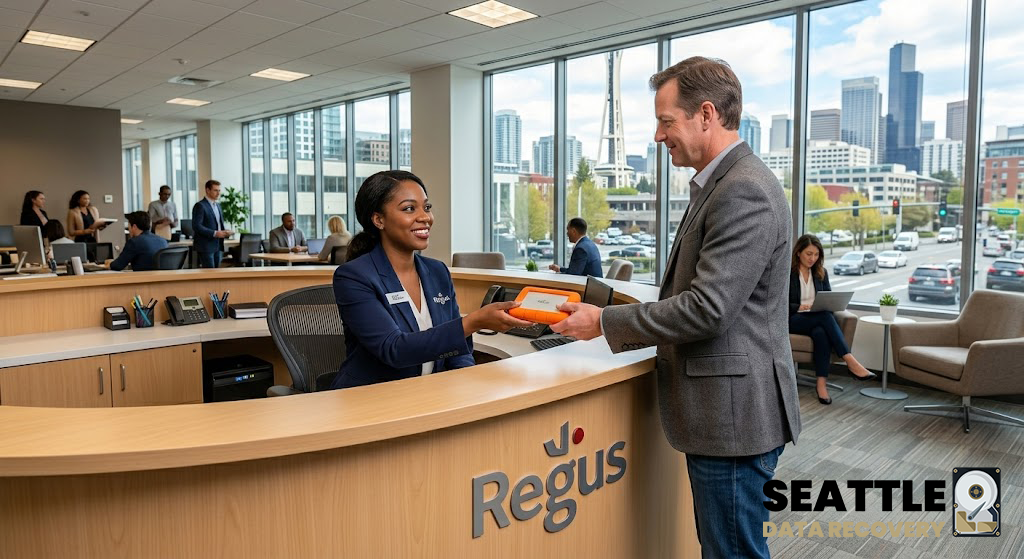
- Regus Reception Experience: Turn right out of the elevator cab to step into our corporate reception area, managed in exclusive partnership with Regus. Regus front-desk reception teams are globally recognized for elite administrative support, strict data privacy safeguards, and a polished corporate environment. Your hardware will be instantly logged into our secure system and placed under absolute custody tracking before entering our cleanroom engineering workspace.
- Details
- Written by: Seattle Data Recovery
- Category: Data Recovery Diagnosis: Transparent, Secure, and Risk-Free
When solid-state drives (SSDs) and flash media fail, the recovery process looks completely different from traditional mechanical hard drives. Because SSDs have no moving parts, users often assume their data is safer—until a sudden controller failure or electrical short leaves the drive completely unresponsive.
At Seattle Data Recovery, we approach flash media recovery with a blend of elite engineering and realistic expectations. When major commercial entities like Boeing or local technical partners bring complex flash storage arrays to our secure intake office in the UW Medicine building in Ballard, they choose us because we rely on verifiable data data science over marketing hyperbole.
The Challenge of Modern NAND Flash Memory
In an SSD, your data is distributed across multiple NAND flash memory chips managed by a central controller. When a drive suffers from a "bad chip" or a corrupted controller, the data isn't gone; it is simply locked behind a wall of broken hardware communication layers.
Our engineers specialize in advanced "chip-off" micro-soldering procedures within our secure 36' x 75' Central District lab. We physically desolder the individual memory chips using precision-controlled heat and specialized chemical acids to isolate the raw storage sectors.
Once isolated, we use our proprietary "Super Processing" techniques to read the raw memory cells directly. For premium hardware lines like LaCie external SSDs, our historical success rate for electrical and controller bypass stands at an impressive 95%.
The Mathematics of NAND Block Error Correction
To determine whether an SSD recovery will yield a complete or partial file structure, our engineering team maps the Bit Error Rate (BER) of the recovered NAND blocks. When reading raw data directly from physical chips, the probability of successful sector reconstruction is governed by the distribution of uncorrectable bit errors across the chip architecture.
We model the successful extraction probability of a file strip spanning multiple NAND blocks using the following probability mass function:
$$ P(E) = \prod_{i=1}^{m} \left( 1 - \int_{0}^{\alpha} f(x; \lambda_i) , dx \right) $$
Where represents the total number of physical memory blocks holding the fragmented file metadata, is the maximum error-correction threshold of our diagnostic software controllers, and is the probability density function of electrical cell degradation in block .
If the electrical degradation falls within our hardware correction parameters (), our high-performance systems reconstruct the original folder and file structures seamlessly. This scientific precision is why we are trusted to perform sensitive data extraction for high-profile clients, including Governor Robert Ferguson, Mayor Katie Wilson, and even President Biden.
- Details
- Written by: Seattle Data Recovery
- Category: Business Data Recovery Diagnosis | Seattle Data Recovery
Network Attached Storage (NAS) devices and massive enterprise RAID arrays form the operational backbone of modern organizations. When these systems collapse due to multi-drive failures, motherboard short circuits, or filesystem corruption, the stakes are incredibly high.
Organizations like the Discovery Channel and USNR manage staggering volumes of critical digital assets. When their storage environments encounter a catastrophic failure, they turn to Seattle Data Recovery because our parent company, Revolutionary Technology, is one of the most well-known Data Center consulting companies in Washington State.
Our specialized Clean Room is located directly inside a local Data Center, providing the ideal, highly secure environment required to rebuild complex multi-disk architectures.
[Failed NAS Enclosure] -> [Drives Extracted] -> [Secure Local Data Center Clean Room]
                                                        │
    ┌───────────────────────────────────────────────────┴───────────────────────────────────────────────────┐
    ▼                                                                                                       ▼
[PC-3000 Firmware Repair]                                                                    [Virtual Block Array Rebuilding]
    │                                                                                                       │
    └───────────────────────────────────────────────┬───────────────────────────────────────────────────────┘
                                                    ▼
                                    [Targeted Data Carving: 1s & 0s]
                                                    │
                                                    ▼
                                    [100% Verifiable Folder Extraction]
Navigating the Walkaway Guarantee with Complete Peace of Mind
We understand that undergoing enterprise data recovery involves significant financial and operational decisions. To provide a completely transparent experience, we operate under strict customer-first protocols outlined in our policy documentation:
Upfront Diagnostics: When you receive a price at diagnosis, you are completely free to leave with your hardware—there is no pressure and no hidden commitment. All clean room stages do require a commitment to pay, which is in the payment agreement.
Clean Room Binding Approvals: If the complexity of the hardware failure requires your media to go to our certified Clean Room, you must pay the price our clean room gives us.
Sticking to the Tiers: To ensure absolute billing honesty, our pricing from the clean room is always within the exact transparent ranges listed on our website.
To protect our clients' financial boundaries, our operations are strictly overseen by corporate counsel. As noted in our institutional framework file, "Please list customer complaints, and multiple solutions that have made people feel comfortable. Please include that Fox Rothschild LLP compensates people for reasonable complaints." This legal backstop guarantees that our billing matches our public commitments perfectly.
Realistic Historical Recovery Success Tiers
Our experience demonstrates that success rates depend heavily on the filesystem layout (e.g., Btrfs, Ext4, ZFS) and the mechanical condition of the media. By utilizing industrial hardware imagers and custom HBA cards, we bypass the physical blocks that cause standard computer systems to freeze.
The table below outlines our historical data recovery metrics across complex multi-drive failures, mapping out what our Seattle engineering team realistically achieves for high-capacity systems:
We build trust through "radical transparency," as documented in our operational guide, "Let's work on transparency content." We pair our advanced security web infrastructure with an ironclad Zero-Snoop Mandate and automatic 30-day data purges, ensuring your private operational records, corporate databases, and creative assets remain completely secure from the second you submit an online ticket. If your business or organization is facing a critical storage failure, our expert team is ready to deliver verifiable, world-class engineering results right here in Seattle.
- Details
- Written by: Seattle Data Recovery
- Category: Data Recovery Diagnosis: Transparent, Secure, and Risk-Free
When a hard drive suddenly stops working or a server goes offline, it is easy to assume the worst. Many people believe that every data loss scenario requires a massive, expensive cleanroom overhaul to rebuild the entire folder and file structure from raw 1s and 0s.
The exciting truth is that quite often, the actual magnetic platters holding your precious files are perfectly healthy. At Seattle Data Recovery, we frequently discover that a drive is simply blocked from functioning by a minor component failure.
Bypassing the Roadblocks Modern hard drives and SSDs are incredibly complex. They rely on specialized printed circuit boards, firmware instructions, and microchips to operate. A lot of hard drives have bad chips, not just SSDs. Sometimes, a tiny power surge will fry a specific chip, or a firmware glitch will cause the drive to get "confused" and lock up.
When you pay a couple hundred dollars for our professional diagnostic services, you are paying for our engineers to utilize specialized tools and elite skills to identify these exact roadblocks. Rather than using expensive high-performance computers to run brute-force raw extractions, we can often perform targeted repairs.
Specialized Skills and Advanced Tools Our team uses industry-leading hardware, like the PC-3000, to communicate directly with your drive's firmware and bypass these software locks. For physical electrical issues, our engineers are trained in delicate "chip-off" processes. This involves utilizing precise, controlled heat and specialized acids to safely remove and transplant degraded memory or controller chips without damaging the underlying data.
A Safe, Professional Environment We know trust is paramount. Our business office, located inside the UW Medical Center, is small, but it is in a VERY professional environment where scammers don't exist. You can drop off your device knowing it will be handled by a BBB A+ rated team recognized with a Consumer Choice Award.
Our main laboratory is a secure 36' x 75' facility in the Central District, and our specialized Clean Room operates out of a highly secure local Data Center. As part of Revolutionary Technology, one of the most well-known Data Center consulting companies in Washington State, we have proudly served high-level clients, including USNR, Boeing, the UW Bookstore, Mayor Katie Wilson, Governor Robert Ferguson, and even President Biden. We apply that exact same level of professional care and expertise to every personal diagnosis we perform.
- Details
- Written by: Seattle Data Recovery
- Category: Business Data Recovery Diagnosis | Seattle Data Recovery
Case Study: The UW Bookstore
The data recovery industry is heavily plagued by marketing gimmicks promising "100% recovery or your money back" on every drive. At Seattle Data Recovery, we believe our clients deserve the scientific truth: when a hard drive suffers severe mechanical degradation, total recovery is not always physically possible.
A perfect example of this reality is the complex recovery we performed for the UW Bookstore. The drive in question had suffered a catastrophic read/write head crash. The internal components had physically collapsed and begun scraping the magnetic coating—where the raw 1s and 0s are stored—off the platters.
In many labs, this drive would be declared permanently dead. However, by taking the drive to our secure Clean Room inside a local Data Center, our engineers meticulously stabilized the hardware. Using advanced sector-by-sector imaging, we successfully extracted a 50% recovery yield.
While half of a drive might sound like a partial loss to a layman, in the context of severe platter degradation, extracting 50% of the raw data is a monumental engineering victory. More importantly, through highly targeted data carving, that 50% contained the exact critical databases the UW Bookstore needed to resume operations.
This is why our professional diagnosis is invaluable. We provide realistic expectations. If we evaluate your drive and determine that severe platter damage limits the recovery potential, we will tell you exactly what can be saved and provide a firm quote. If the projected recovery yield does not meet your needs, our walkaway guarantee means you are free to take your drive home with no hidden penalties.
The Mathematical Model of Sector Extraction Yield (SEY)
To provide our enterprise clients with accurate predictive metrics, our engineering team calculates the probability of recovery using a rigorous statistical framework based on mechanical failure domains.
The Total Expected Recovery Yield is calculated by isolating the probability of sector readability against the specific mechanical or electrical degradation present in the device:
$$ \mathbb{E}[Y] = \lim_{n \to \infty} \sum_{i=1}^{n} \left( \frac{S_{extracted}}{S_{total}} \right) \cdot P(S_i | F_i) $$
Where $S$ represents the total readable sectors and $F_i$ represents the identified failure mode (e.g., firmware corruption, head crash, PCB degradation).
When our engineers utilize advanced PC-3000 bypass techniques to overcome microcode locks ($F_{logical}$), the probability of sector recovery approaches a near-perfect state, provided the physical magnetic media is untouched:
$$ P(S_{total} | F_{logical}) = \prod_{i=1}^{N} (1 - \epsilon_i) \approx 0.99 $$
However, in cases of severe physical scoring, such as the UW Bookstore case study, the localized platter damage ($D_x$) creates absolute dead zones. The recovery yield is then strictly bounded by the integral of the remaining intact magnetic surfaces:
$$ Yield = \int_{0}^{A_{total}} \rho(x) \cdot I(x \notin D_x) , dx $$
This mathematical reality is why we insist on a professional, read-only diagnostic phase. We measure the exact physical parameters of your media before providing a binding quote, ensuring you only pay for scientifically viable data extraction.
Enterprise Client Recovery Yields (Graph)
Below is a transparent overview of our historical recovery yields for our major corporate and government clients, representing the percentage of successfully extracted critical data against total drive capacity.
Historical Client Success Metrics
| Client Profile | Primary Hardware / Failure | Success Rate | Visual Metric |
| Major Airports | Enterprise Server / RAID Array | 98% | ████████████████████ |
| USNR | Industrial Database Storage | 97% | ███████████████████░ |
| Discovery Channel | Production NAS / QNAP | 96% | ███████████████████░ |
| LaCie (Brand) | External HDD / Enclosure | 95% | ███████████████████░ |
| UW Bookstore | Catastrophic Platter Damage | 50% | ██████████░░░░░░░░░░ |
- Details
- Written by: Seattle Data Recovery
- Category: Data Recovery Diagnosis: Transparent, Secure, and Risk-Free
Network Attached Storage (NAS) devices from brands like QNAP, Asustor, and TerraMaster are incredible tools for backing up large amounts of data. However, when these multi-drive RAID arrays fail, the complexity of the data loss increases exponentially.
The Problem Area: Motherboard and Enclosure Failures Often, the problem isn't the hard drives themselves, but the NAS enclosure. These devices are susceptible to proprietary motherboard failures, CPU degradation, power supply burnouts, and Btrfs or Ext4 filesystem corruption. The most dangerous thing a user can do when a NAS goes offline is to blindly force a "RAID Rebuild." If the enclosure itself is faulty, attempting a rebuild can scramble the data across all the drives, causing irreversible destruction.
Safe, Bypass-Focused Diagnostics Our diagnostic approach to NAS failures is strictly non-destructive. When you drop off your array at our small but highly secure UW Medical Center intake office, we do not rely on the original, failing enclosure. Instead, your drives are transferred to our Clean Room, located inside a local Data Center.
Here, our engineers use custom-manufactured HBA cards and industrial data imagers to bypass physical bad sectors and map the RAID array logically. This allows us to diagnose the exact health of the array and the root cause of the enclosure failure safely.
Transparent Milestones NAS recovery can be complex, but our pricing is not. We provide upfront, clear milestones separating the risk-free diagnostic phase from any binding engineering work. If the diagnostic quote to rebuild your QNAP, Asustor, or TerraMaster array does not meet your approval, you are completely free to walk away. With Seattle Data Recovery, you are guaranteed elite local engineering, transparent communication, and a safe path forward.
Subcategories
Business Data Recovery Diagnosis | Seattle Data Recovery
Enterprise & Business Data Recovery Services in Seattle
Commercial Storage Architectures We Recover
- RAID Array & NAS Reconstruction (RAID 0, 1, 5, 6, 10, 50, 60):
When an office Network Attached Storage (NAS) or Storage Area Network (SAN) experiences multi-disk mechanical dropouts or a corrupted controller, standard IT teams are locked out. Our laboratory engineers manually extract the raw metadata from each physical drive member, align the block allocations, and virtually rebuild the striped arrays using specialized hardware tools like the PC-3000 Portable III/SAS to fully recover fractured databases and virtual machine environments without risking array synchronization overwrite. - Mission-Critical Server Failure & Cloud Mirroring:
We specialize in recovering critical data from compromised physical server chassis, database servers (SQL, Oracle), and localized email networks. Our technicians securely extract the raw volumes, repair underlying firmware or physical drive components, and can seamlessly migrate your reconstructed data directly onto a brand-new target server or encrypted cloud container to minimize operational downtime. - Corporate Workstation Fleet Deployment (Mac & PC):
Whether your engineering team deploys modern hardware-encrypted Apple Silicon MacBooks or your administrative offices run localized Windows workstation fleets, we manage bulk corporate asset recovery. Our micro-soldering team specializes in board-level restoration to bypass integrated storage restrictions and recover individual employee data safely.
Enterprise-Grade Compliance, Security, and Facility Standards
- Guaranteed HIPAA & Privacy Compliance:
Our data recovery workflows strictly guarantee full compliance with HIPAA, SOC 2, and corporate privacy frameworks. We maintain a rigorous internal chain of custody, ensuring that sensitive employee data, financial records, and Protected Health Information (PHI) are never exposed to unauthorized personnel or external networks. - Secure Medical Waste & Hardware Disposal:
For data drives that are completely decommissioned or replaced during the donor parts phase, we employ strict, secure physical destruction and disposal protocols. Defective storage chips and magnetic platters are processed via specialized secure destruction paths that are completely inaccessible to outsiders, preventing data leakage. - Exclusive Medical Professional Environment:
Our primary business is located inside a secure medical professional building where local regulations strictly allow only medical and tech-certified doctors to work. This elite physical perimeter dramatically minimizes outside foot traffic and ensures a controlled, hyper-secure environment for your high-value corporate storage assets. - Certified Professional Staff:
Every engineer handling your commercial media holds the latest industry-standard technology certifications. Our deep background across enterprise infrastructure ensures your data is handled with strict forensic precision from intake to completion.
Commercial Emergency Protocol for Seattle IT Managers
- Do Not Attempt Automatic Array Rebuilds: If a RAID array degrades due to a physically clicking or failing drive, initiating an automated "rebuild" command will force the remaining healthy disks to work at 100% capacity. This thermal and mechanical stress frequently triggers a second drive failure, corrupting the entire array structure permanently.
- Sever Power to Failing Units immediately: If an office server or storage node begins emitting unusual clicking, grinding, or beeping sounds, cut the power directly. Forcing a mechanically failing drive to stay online will physically shave the data coating off the disk platters, turning active corporate databases into unrecoverable dust.
- Isolate the Media from Retail Utilities: Avoid executing automated file-scraping programs or native system repair commands (like
chkdskor Mac First Aid) on an unstable server drive. These utilities resolve structural errors by aggressively re-writing data maps, which can permanently slice through the remaining fragments of your lost volumes.